Room Sealing
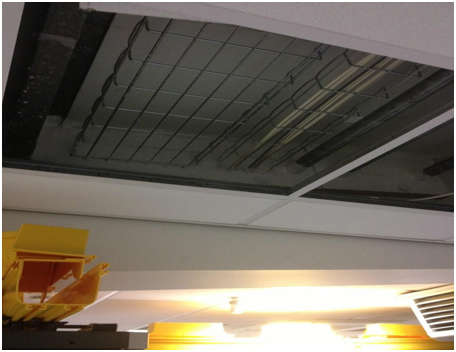
Type of Enclosure
The construction method of any enclosure is important when trying to seal the room to a sufficient level.
Block and concrete walls from slab to slab are more advantageous than plasterboard partitions when trying to achieve a positive result.
The size of the enclosure also plays a significant part.
The larger the enclosure the more allowable leakage is allowed.
The smaller the enclosure the more difficult it becomes as the allowable leakage is minimal.
The criteria to determine whether the amount of leakage is acceptable is based on the time it takes for the agent interface to reach the highest point of any protected equipment.
The minimum required hold time is 10 minutes (unless Co2) so the room height can play a significant part.
If the protected equipment within the enclosure is too high in relation to the ceiling/slab height a positive Integrity Test result is unlikely.
Retrotec Inc. advise that any protected equipment installed should be no higher than 75% of the overall slab to slab height.
Sealing
It is important to prevent the egress of smoke from outside the enclosure, as well as maintaining a high concentration of clean air agent within.
The sealing of any enclosure protected with a gas suppression system has to be of a very high standard, higher than that of normal building practice.
Our experience shows that normal building works are insufficient in creating an air tight seal within most enclosures.
All holes, cracks and service penetrations should be sealed around all perimeter walls at high and low level.
Any service penetrations to floor or ceiling slabs should also be sealed using appropriate materials.
All plasterboard joints and any other construction joints in walls, ceilings or floors should be sealed with Intumescent mastic.
Porous block walls should be painted with an Intumescent coating.
Windows and other glazed areas should be sealed with a transparent silicone mastic.
Doors should have adequate drop down seals applied at bottom of door and weather stripping around frame.
Materials
Sealing works should be carried out using the correct materials such as Intumescent Fire Batt, mastic and coating.
We often find that expanding foam is used frequently by others in sealing enclosures which causes numerous problems.
Not only is it very untidy, but is also porous.
Pillows placed in cable trays do not create an airtight seal and are often taken out due to new cable runs and not replaced.
Fresh air supplies and Extracts.
All fresh air supplies and extracts should be fitted with motorized dampers which close in the event of a fire activation maintaining a high concentration of agent within the enclosure.